How the symmetry test works
- 1
Add a front-facing photo
Choose a clear, front-facing picture. Before measuring, the tool runs a quick quality check that rejects photos with no face, more than one face, a face that is too small or too dark, or a head turned or tilted too far. A turned head changes the left-right proportions in a photo, so face the camera straight on.
- 2
Find the centre line
A face model runs inside your browser tab and places 478 3-dimensional points on your face. The tool draws a vertical centre line from the top of the face mesh (mid-forehead, not the hairline) down to the chin. Because heights are measured along this midline, a slight sideways head tilt (roll) does not skew your result.
- 3
Mirror and compare
Each right-side point is reflected across your midline and compared with its matching left-side partner. The average miss across 13 pairs, divided by your pupil distance, becomes your overall percentage score. Vertical differences for your eyes, brows and mouth corners, plus a separate jaw score, are shown as individual readings.
What we measure
Symmetry here means one concrete thing: how closely the left half of your face mirrors the right half in this specific photo. Every score comes from the same 478-point mesh, and you can inspect the measurement lines drawn on your image or save a share card with your photo hidden by default.
Overall symmetry
DeviceThirteen left-right landmark pairs are compared: forehead edges, cheekbones, jaw corners, outer eye corners, inner eye corners, upper eyelids (two pairs), lower eyelids (two pairs), mouth corners, nostrils, brow tails and pupils. Each right-side point is mirrored across the forehead-to-chin midline, and the average distance to its left-side partner is divided by the distance between your pupils. That ratio is subtracted from 1 and multiplied by 100 (clamped between 0 and 100), so 100% means a perfect mirror.
Eye level difference
DeviceThe vertical height difference between your left pupil and right pupil, measured along the forehead-to-chin midline and expressed as a percentage of face height. Lower numbers mean the pupils sit closer to the same height; compare yours with the calibration band below.
Brow level difference
DeviceThe vertical height difference between your left brow peak and right brow peak, expressed as a percentage of face height. Eyebrows move with expression and grooming, so this reading can change from one photo to the next.
Mouth corner level
DeviceThe vertical height difference between your left mouth corner and right mouth corner, expressed as a percentage of face height. A half-smile or a tense jaw can lift one corner, so a relaxed, closed mouth gives the clearest reading.
Jaw symmetry
DeviceSix left-right landmark pairs traced along the lower jaw outline, from the jaw corners down to either side of the chin. Each right-side jaw point is mirrored across the midline and compared with its left partner, with the average distance divided by mean eye width to produce a percentage score.
What facial symmetry actually measures
When people look in a mirror or take a selfie, they often notice that one eyebrow sits slightly higher, one eyelid looks different, or one side of the jaw looks fuller. A face symmetry test turns those visual impressions into plain geometric comparisons. Instead of judging whether a face looks good or bad, the test asks how closely the coordinates on the right side match the coordinates on the left side when folded across a central axis.
Camera angle, lighting and expression can all introduce apparent asymmetry in a two-dimensional picture, so a score tells you about the geometry of one photo, not a permanent verdict on your face.
Because a 2D photo flattens a 3D head onto a screen, photos taken in different rooms, at different distances or with different lenses can give different numbers. Testing the exact same photo file twice always produces identical numbers.
How our browser tool calculates your symmetry step by step
When you select an image, it is not uploaded. Your browser loads the MediaPipe Face Landmarker model (about 4 MB, downloaded once) and checks that a single face is present. If the face is too small, too dark, or the head is turned sideways (yaw) or tilted up or down (pitch) too far, the quality check stops and asks for a clearer shot before computing any ratios.
The face mesh approach comes from work such as Kartynnik and colleagues (2019), who described a neural network that infers an approximate 3D mesh of a face from single-camera input.1
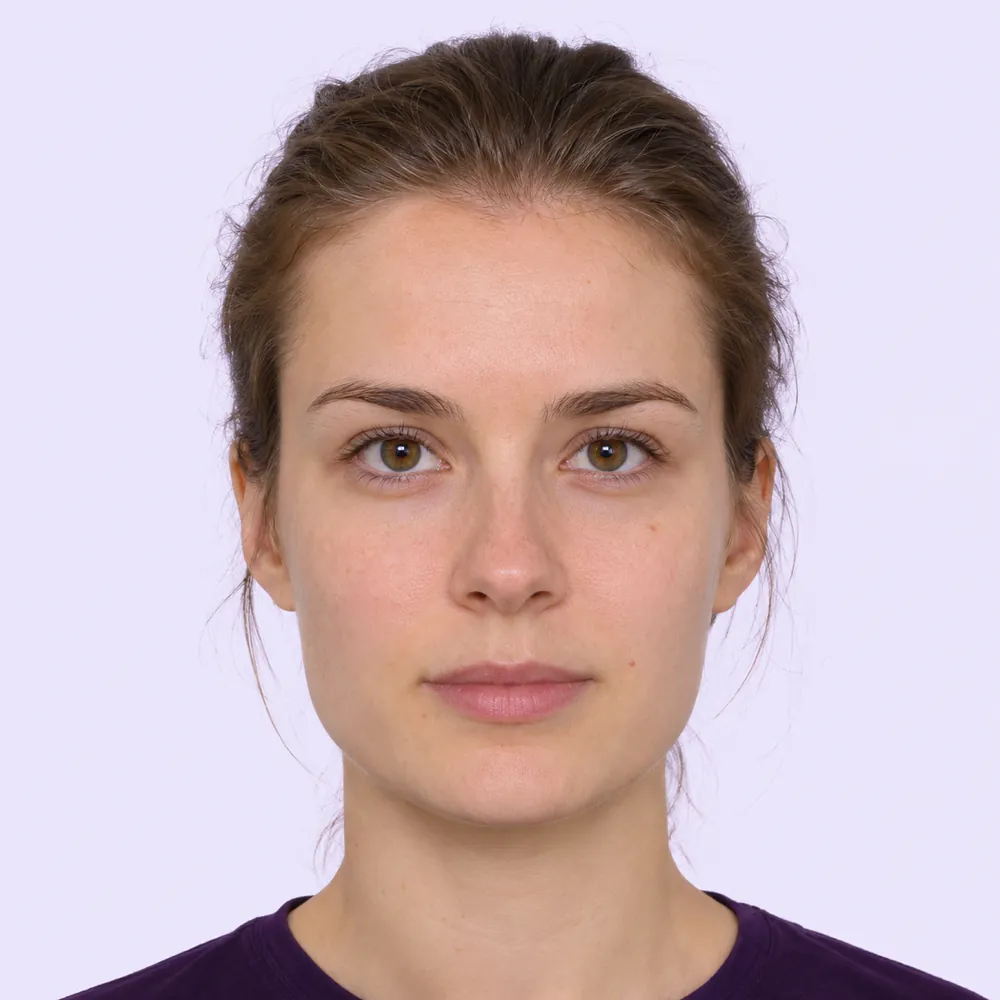
Pink dots mark detected facial features; pink lines connect the measured widths, face length and eye corners.
The Face Landmarker outputs an estimate of 478 3-dimensional landmarks, a mesh that follows the contours of your forehead, eyes, brows, nose, lips and jawline. To keep a slight sideways head tilt from affecting the comparison, the tool anchors a vertical midline from the top of the face mesh (mid-forehead, not the hairline) to the bottom of the chin, and all vertical height comparisons are measured along this line.
To compute Overall symmetry, the tool takes 13 paired landmarks: forehead edges, cheekbones, jaw corners, inner and outer eye corners, two pairs on the upper eyelids, two pairs on the lower eyelids, mouth corners, nostrils, brow tails and pupils. Each right-side point is reflected across the midline, and the distance between the reflected point and the actual left-side point is averaged across all 13 pairs. Dividing that average miss by your pupil-to-pupil distance accounts for face size, producing a percentage score where 100% represents an exact mirror.
Alongside the overall score, the tool runs four targeted checks. Jaw symmetry mirrors six paired points along the lower jaw outline and divides the average miss by mean eye width. Eye level difference, Brow level difference and Mouth corner level measure the vertical gap between left and right pupils, brow peaks and mouth corners as a percentage of face height.
What psychology research says about facial symmetry
Researchers have studied facial symmetry for decades to understand how people perceive faces. In an early study using computerized facial images and composites, Grammer and Thornhill (1994) measured symmetry, averageness and the size of facial features, and reported that facial symmetry had a positive influence on attractiveness ratings when men and women rated opposite-sex faces.2
Earlier studies that manipulated face images had reported a preference for asymmetry, and Perrett and colleagues (1999) suggested this may reflect unnatural feature shapes and skin textures introduced by image processing. When they varied the shape of facial features while holding skin texture constant, increasing the symmetry of face shape increased attractiveness ratings for both male and female faces.3
Symmetry is not the only factor studied. Langlois and Roggman (1990) found that computer-generated composite faces, made by averaging a sample of faces, were judged more attractive than almost all of the individual faces used to build them, and the composites became more attractive as more faces were averaged.5
In a critical review with meta-analyses, Rhodes (2006) reported that averageness, symmetry and sexual dimorphism are all attractive in both male and female faces and across cultures, and argued that both evolutionary selection pressures and the way brains process information may have shaped these preferences. These studies concern ratings of faces in research settings, and they do not set a pass-or-fail standard for any individual face.4
Reading your numbers against our calibration faces
Because the face landmarker fits a canonical 3D mesh to your photo, real faces span a narrow band of ratios. To give you context for how the mesh behaves, we ran 133 real front-facing photos from Pexels through the same engine. These calibration photos provide a reference for mesh measurements. They are not a representative population sample, so the resulting bands are a mesh reference, not population norms.
On our calibration faces, the middle 80% ranged from 82.0% to 98.3% for Overall symmetry (median 92.5%), and from 33.5% to 95.3% for Jaw symmetry (median 74.1%).
Number of photos
- Median:
- 92.5%
- Middle 80%:
- 82%–98.3%
For the three vertical level checks, smaller percentages mean closer alignment. On our calibration faces, the middle 80% ranged from 0.1% to 1.6% for Eye level difference (median 0.5%), 0.1% to 2.6% for Brow level difference (median 0.7%), and 0.1% to 1.7% for Mouth corner level (median 0.7%). If your brow level is above 2.6% or your mouth level is above 1.7%, check your photo first for a faint smile, a raised eyebrow or a shadow along one cheek, then retake it before drawing conclusions.
Practical ways to style and photograph for visual balance
If you want your photos to look more balanced, camera setup and grooming are the places to start. Hold the camera at eye level straight in front of you, step back a little and zoom in rather than holding the phone close, and face a window or soft lamp so both cheeks get similar light.
Hair and brows are easy, reversible adjustments. A centre part or balanced fringe frames both sides evenly, while a deep side part draws the eye to one side. For brows, brush them in the same direction and tidy only stray hairs rather than reshaping one side to match the other.
Front and level
Turned or looking up/down
Too dark
More than one face
Glasses that sit level on your nose give a straight reference line across the upper face. Keeping hair off your forehead, temples and jawline also lets the tool see those outline points clearly.
Reading your symmetry score
A score of 100% means an exact mirror in this photo. The bands below come from our calibration photos, not from a representative population sample, so read your score as a description of how evenly this photo lines up, not as a personal grade.
| Score | What it means | What usually causes it |
|---|---|---|
| 82.0–98.3% | Middle 80% of our calibration faces (median 92.5%) | Left and right sides mirror closely in this photo |
| Above 98.3% | Higher than 90% of our calibration faces | Very close mirroring in this photo |
| Below 82.0% | Lower than 90% of our calibration faces | Real left-right differences, or a turned head, uneven light or an expression; retake the photo to check |
What the symmetry test can't tell you
- It measures a single 2D photo, not a 3D scan. Lens focal length, camera distance, head angle and facial expression can all shift the 478 landmarks, so only compare photos taken under the same conditions.
- The face landmarker fits a canonical face mesh to your image, so real faces span a narrow band of ratios.
- Our reference numbers come from 133 real front-facing photos used to benchmark the mesh, not from a real-world population study, so they cannot tell you how you compare with other people.
- Symmetry is one geometric measurement in one photo. It is not a verdict on how a face looks or who someone is.
- Only the face mesh points are measured, so anything outside them is not reflected in your numbers.
- Heavy shadows, glasses glare, or hair covering the cheekbones and jawline can make landmark placement less accurate and affect the readout.
Photo tips for an accurate symmetry score
Face the camera straight on
Hold the camera at eye level and look directly into the lens. A head turn (yaw) or chin tilt (pitch) changes the left-right proportions in the photo, and the tool will reject photos where the angle is too large.
Use even, front-facing light
Stand facing a window or a soft, diffused lamp so both cheeks receive similar brightness. Strong side lighting casts shadows across one side of the face, which can make landmark placement less accurate.
Keep a relaxed, neutral expression
Rest your jaw, keep your lips gently closed, and relax your forehead. A smile or a tense mouth can change the mouth corner reading and other measurements.
Pull hair away from your face
Tuck hair behind your ears and clear bangs away from your forehead and brows. When hair covers the forehead edges, temples or jawline, those outline points are harder for the model to place.
Questions
References
- Kartynnik, Y., Ablavatski, A., Grishchenko, I., & Grundmann, M. (2019). Real-time facial surface geometry from monocular video on mobile GPUs. arXiv:1907.06724. arxiv.org/abs/1907.06724
- Grammer, K., & Thornhill, R. (1994). Human (Homo sapiens) facial attractiveness and sexual selection: The role of symmetry and averageness. Journal of Comparative Psychology, 108(3), 233–242. doi.org/10.1037/0735-7036.108.3.233
- Perrett, D. I., Burt, D. M., Penton-Voak, I. S., Lee, K. J., Rowland, D. A., & Edwards, R. (1999). Symmetry and human facial attractiveness. Evolution and Human Behavior, 20(5), 295–307. doi.org/10.1016/s1090-5138(99)00014-8
- Rhodes, G. (2006). The evolutionary psychology of facial beauty. Annual Review of Psychology, 57, 199–226. doi.org/10.1146/annurev.psych.57.102904.190208
- Langlois, J. H., & Roggman, L. A. (1990). Attractive faces are only average. Psychological Science, 1(2), 115–121. doi.org/10.1111/j.1467-9280.1990.tb00079.x